Project Page

FeaXDrive: Feasibility-aware Trajectory-Centric Diffusion Planning for End-to-End Autonomous Driving

Baoyun Wang · Zhuoren Li · Ran Yu · Yu Che · Xinrui Zhang · Ming Liu · Jia Hu · Chen Lv · Bo Leng

Tongji University · Nanyang Technological University

Overview of FeaXDrive
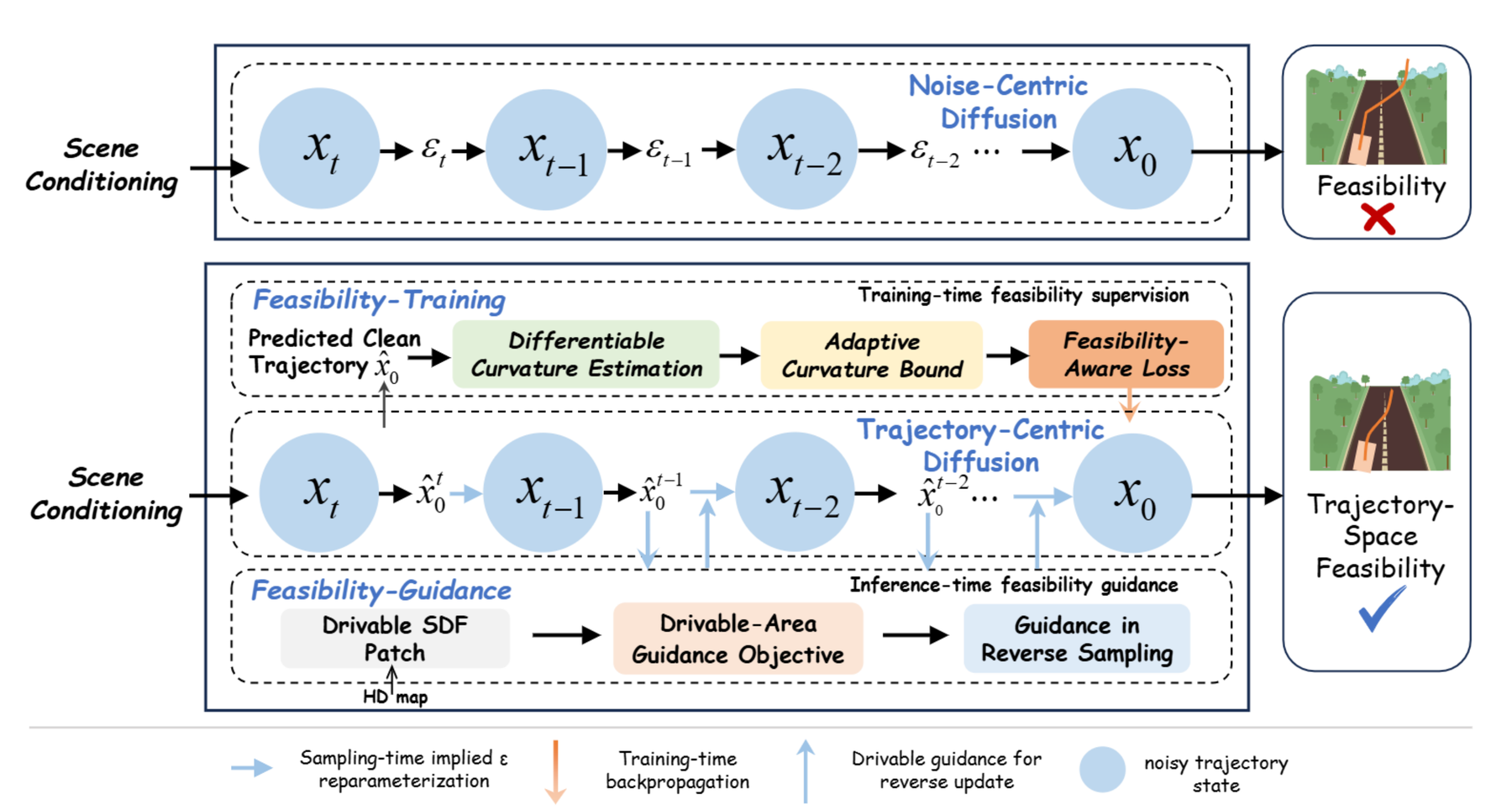
Overview of FeaXDrive. Compared with noise-centric diffusion planning, FeaXDrive adopts a trajectory-centric formulation in which the predicted clean trajectory serves as the unified object for feasibility-aware modeling. On this basis, the method combines feasibility-aware training and inference-time drivable-area guidance to enhance trajectory-space feasibility throughout the diffusion planning process.

Abstract

End-to-end diffusion planning has shown strong potential for autonomous driving, but the physical feasibility of generated trajectories remains insufficiently addressed. In particular, generated trajectories may exhibit local geometric irregularities, violate trajectory-level kinematic constraints, or deviate from the drivable area, indicating that the commonly used noise-centric formulation in diffusion planning is not yet well aligned with the trajectory space where feasibility is more naturally characterized. To address this issue, we propose FeaXDrive, a feasibility-aware trajectory-centric diffusion planning method for end-to-end autonomous driving. The core idea is to treat the clean trajectory as the unified object for feasibility-aware modeling throughout the diffusion process. Built on this trajectory-centric formulation, FeaXDrive integrates adaptive curvature-constrained training to improve intrinsic geometric and kinematic feasibility, drivable-area guidance within reverse diffusion sampling to enhance consistency with the drivable area, and feasibility-aware GRPO post-training to further improve planning performance while balancing trajectory-space feasibility. Experiments on the NAVSIM benchmark show that FeaXDrive achieves strong closed-loop planning performance while substantially improving trajectory-space feasibility. These findings highlight the importance of explicitly modeling trajectory-space feasibility in end-to-end diffusion planning and provide a step toward more reliable and physically grounded autonomous driving planners.
Contributions

FeaXDrive builds a unified feasibility-aware pipeline across training, inference, and post-training in clean trajectory space.

01

Trajectory-centric feasibility-aware diffusion planning

We propose a trajectory-centric diffusion planning framework with feasibility-aware training and inference for autonomous driving. By treating the clean trajectory as the central object for feasibility-aware modeling throughout the diffusion process, the framework provides a unified interface for training-time feasibility enhancement and inference-time geometric guidance in trajectory space.

02

Adaptive differentiable curvature training

We introduce an adaptive differentiable curvature training strategy to improve the intrinsic feasibility of generated trajectories. By directly imposing adaptive curvature constraints on the predicted clean trajectory, the method suppresses local geometric irregularities and curvature spikes while improving trajectory-level kinematic feasibility.

03

Drivable-aware sampling guidance

We develop a drivable-aware sampling guidance strategy for diffusion sampling to improve drivable-area consistency during inference. By injecting local road-geometry priors into the clean trajectory at each reverse sampling step, the method enables scene-aware geometric correction within the sampling loop.

04

Feasibility-aware GRPO fine-tuning

We further incorporate feasibility-aware Group Relative Policy Optimization (GRPO) fine-tuning into the end-to-end diffusion planner. By optimizing a feasibility-augmented reward that jointly captures benchmark-oriented performance and trajectory-space feasibility preference, this stage further improves planning performance while balancing trajectory-space feasibility.

Method

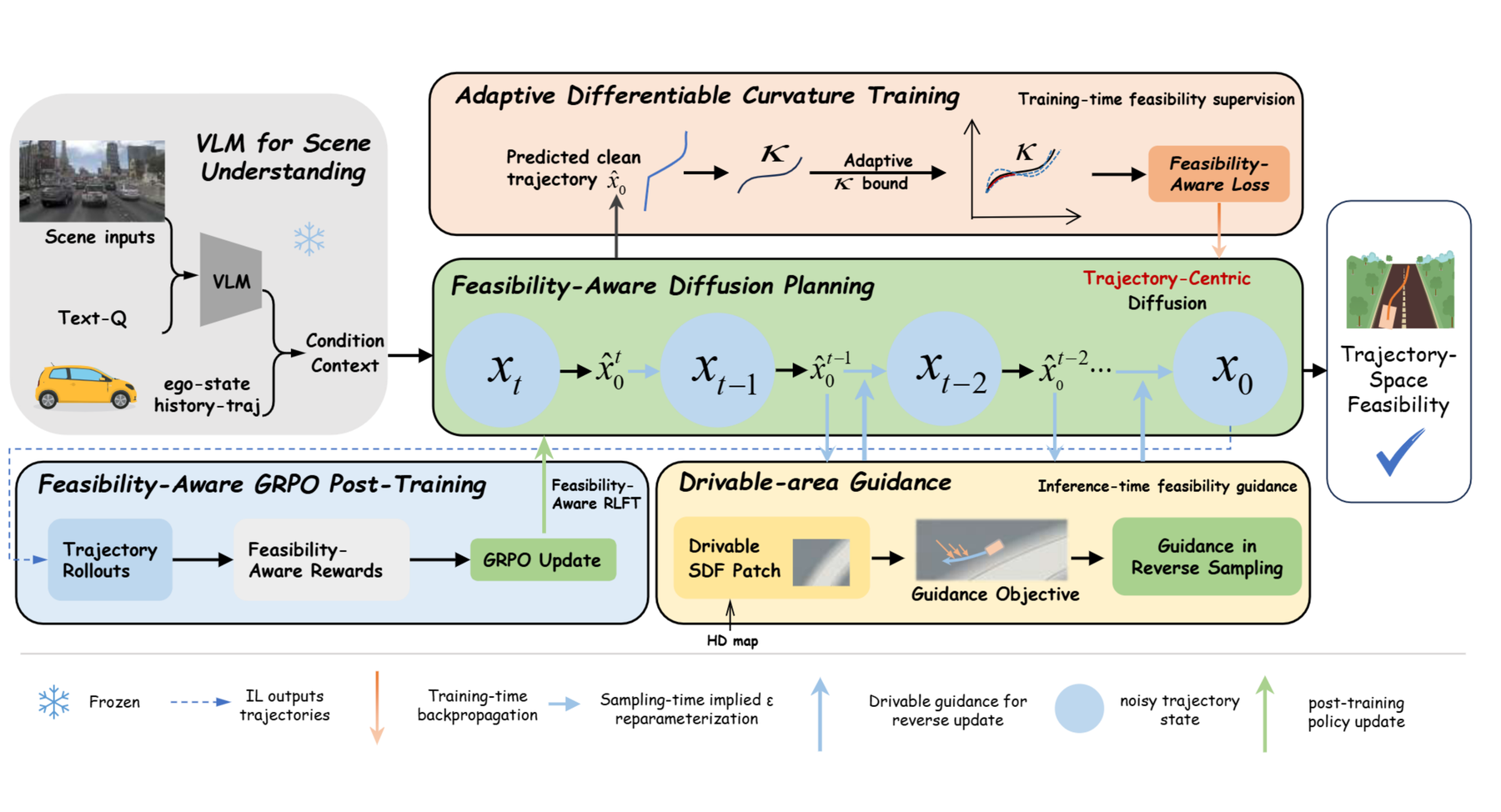
The predicted clean trajectory is the shared object for feasibility-aware modeling in training, inference, and post-training.

Overall architecture of FeaXDrive
Overall architecture of FeaXDrive. Under a trajectory-centric formulation, the predicted clean trajectory serves as the shared object for feasibility-aware modeling throughout training, inference, and post-training. The method integrates adaptive differentiable curvature-constrained training, drivable-area guidance during reverse diffusion sampling, and feasibility-aware GRPO post-training.

Adaptive Curvature-Constrained Training

During training, FeaXDrive directly imposes adaptive differentiable curvature constraints on the predicted clean trajectory in trajectory space. This improves intrinsic geometric regularity, suppresses curvature spikes, and enhances trajectory-level kinematic feasibility.

Constraint-Aware Inference with Drivable-Area Guidance

During reverse diffusion sampling, the current clean trajectory estimate is guided with local road-geometry priors. Using a footprint-level drivable-area objective, the method performs online progressive correction so that the trajectory stays better aligned with the drivable region.

Feasibility-Aware GRPO Fine-Tuning Optimization

In post-training, FeaXDrive introduces feasibility-aware GRPO to optimize the planner with rewards that jointly reflect benchmark performance and trajectory-space feasibility, further improving the performance-feasibility trade-off.

Qualitative Results

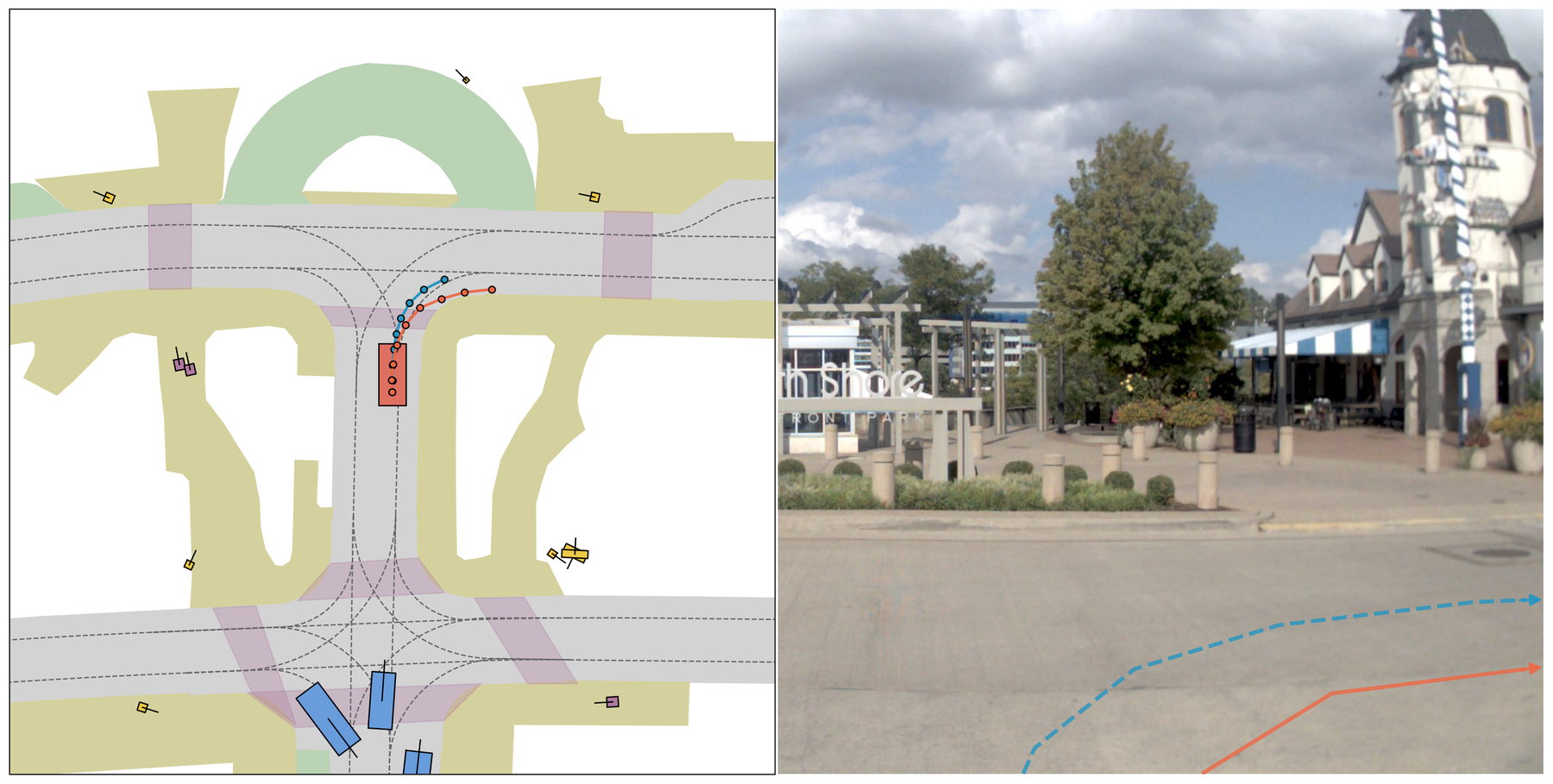
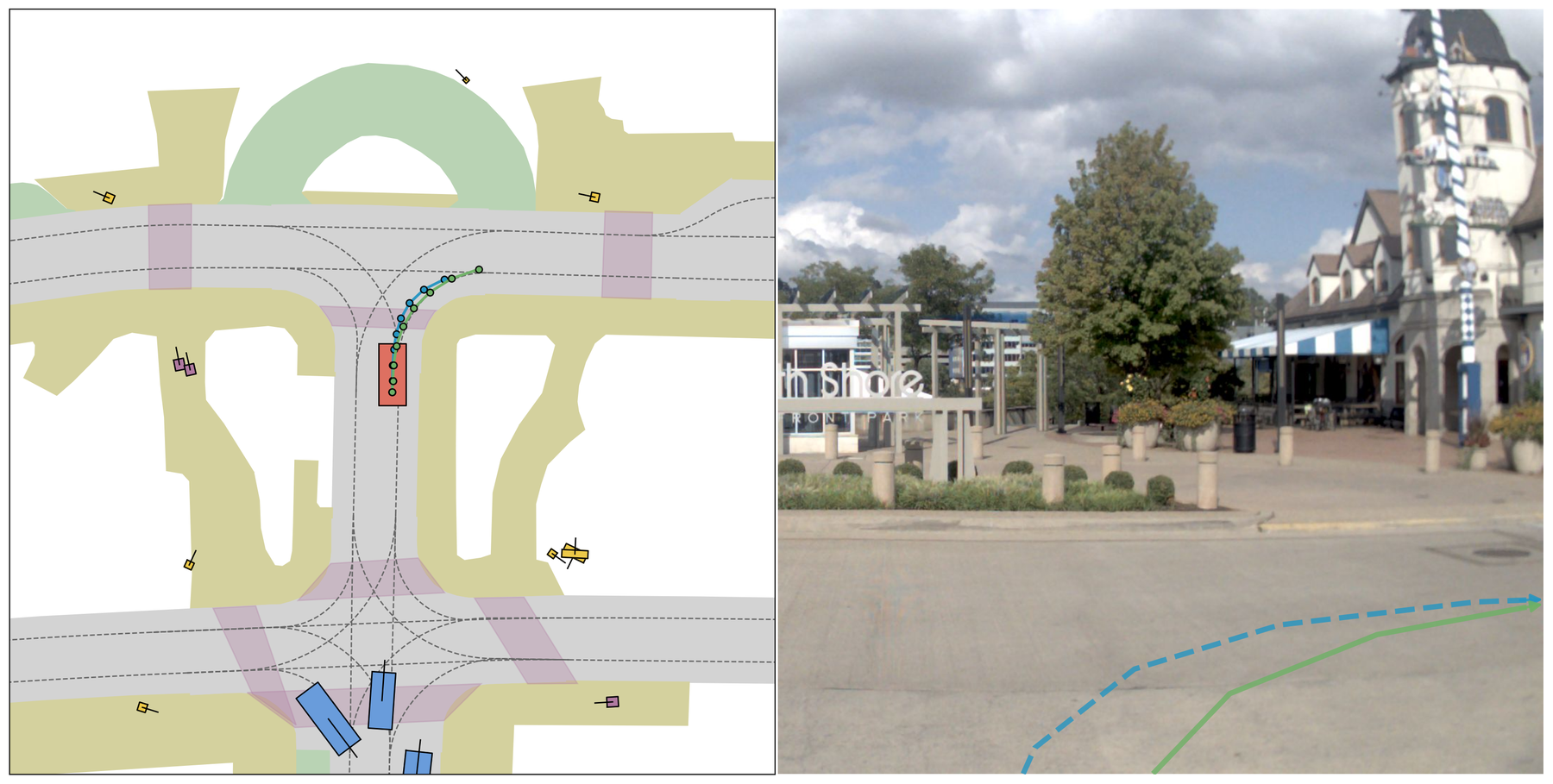
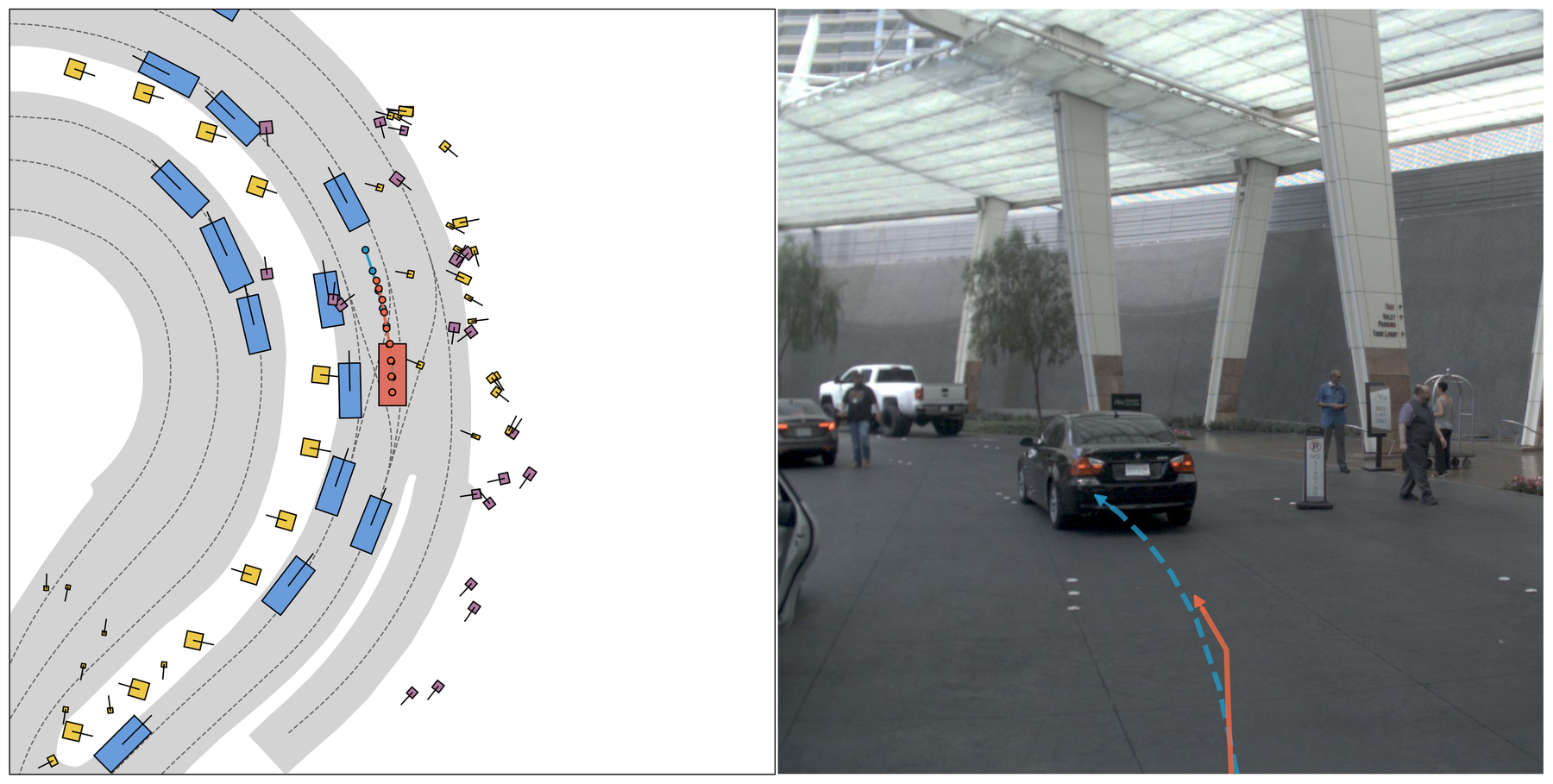
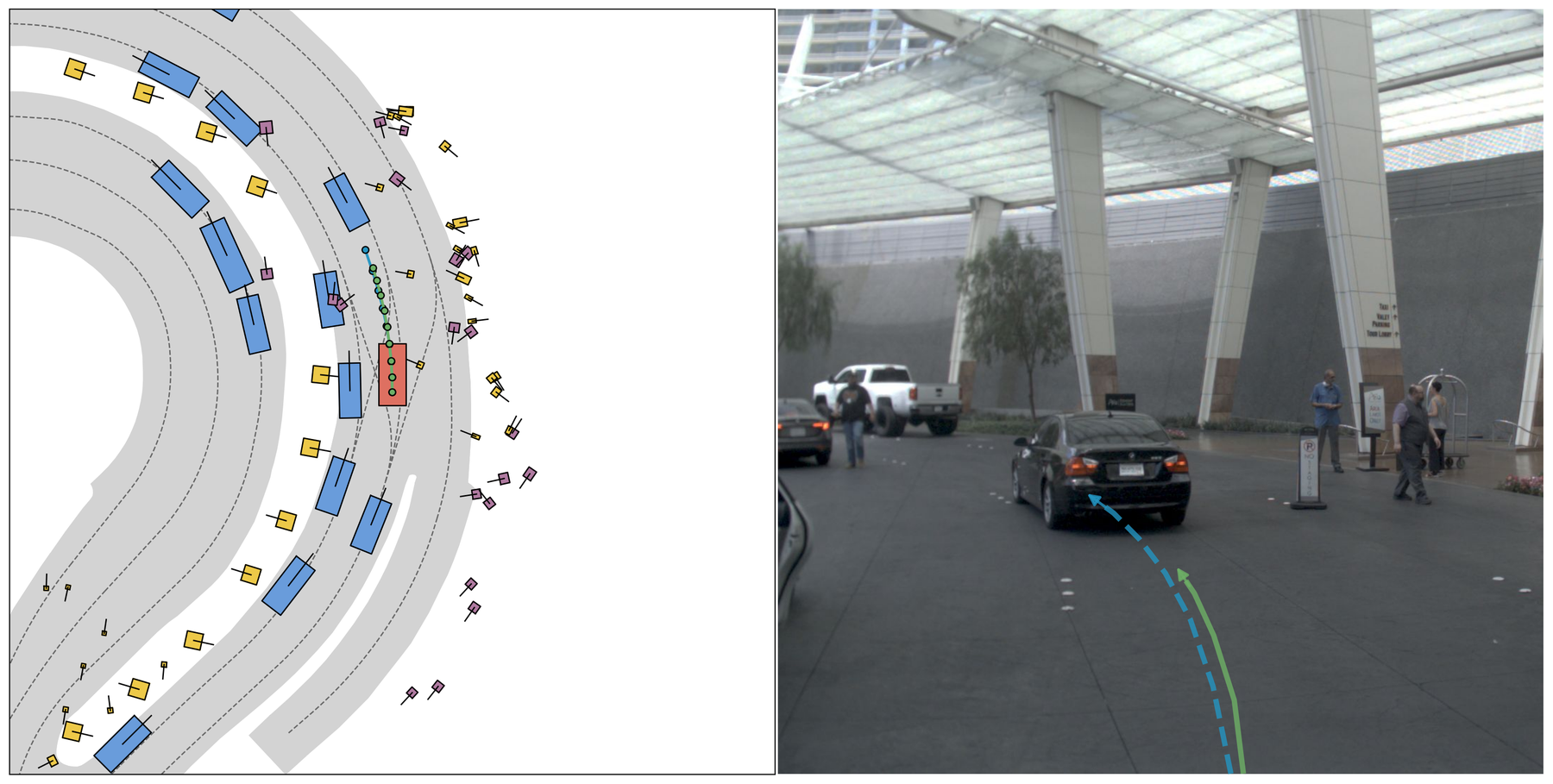
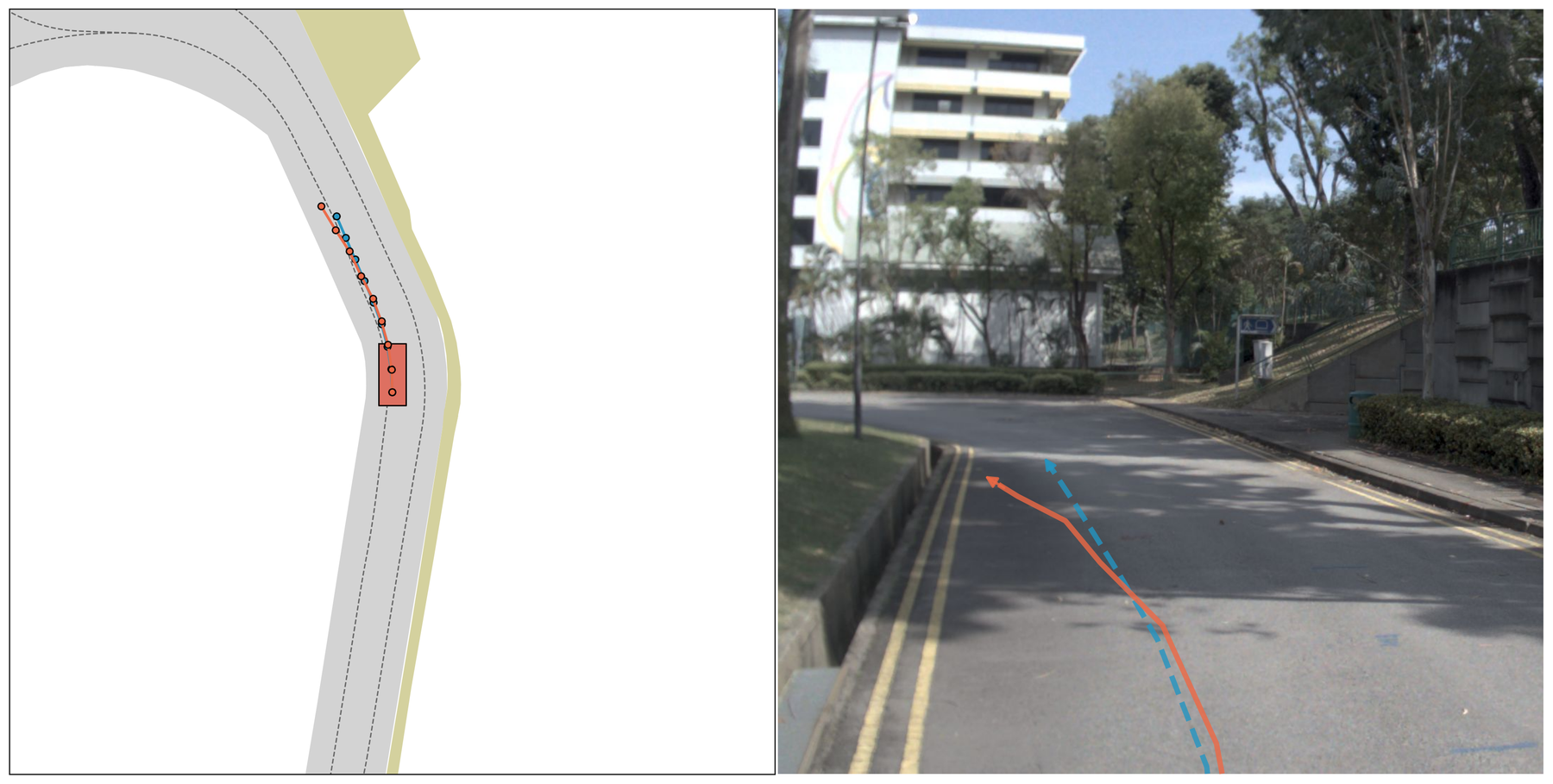
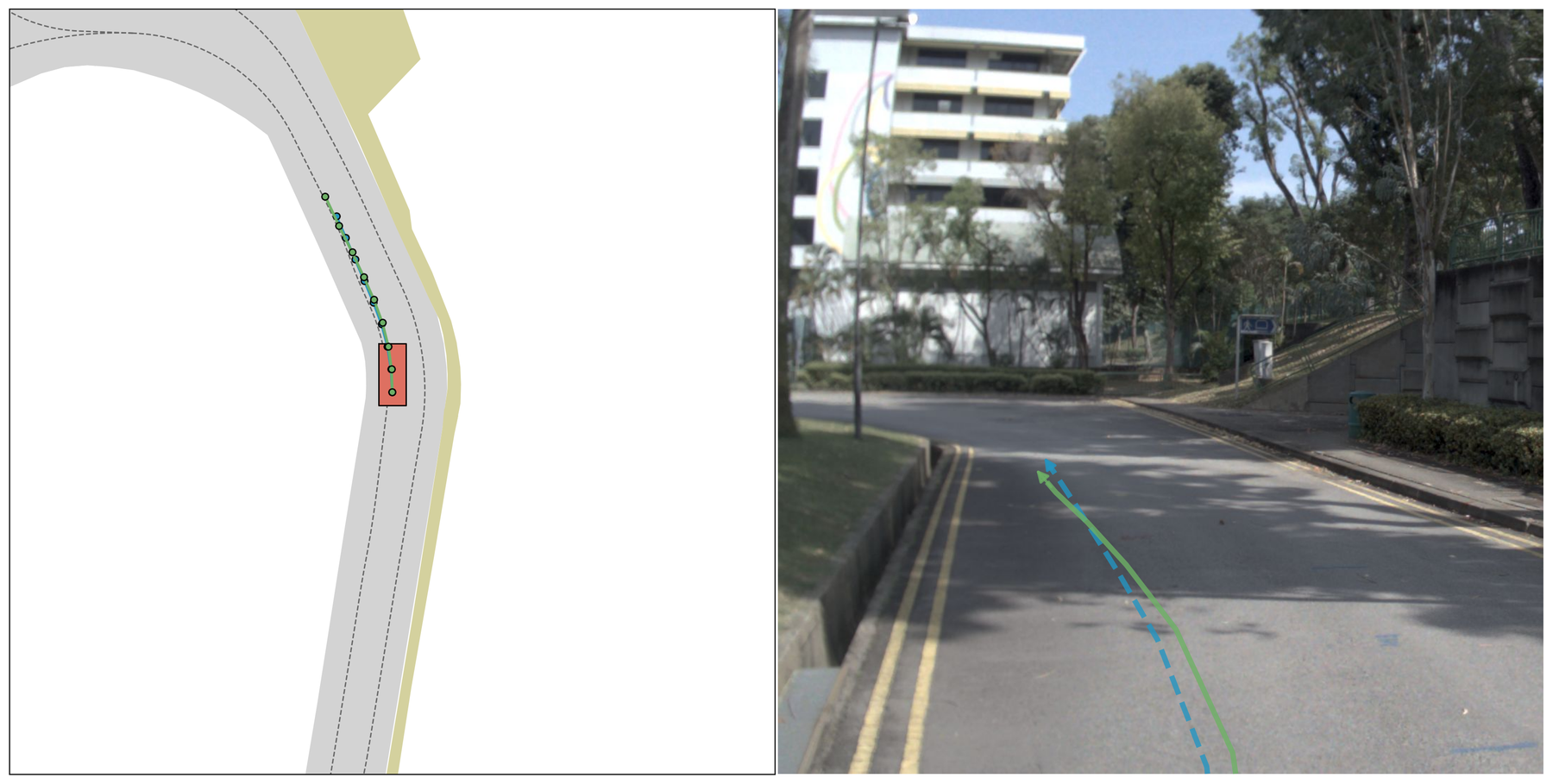
Qualitative comparison between the noise-centric baseline and FeaXDrive on representative planning scenes.

Case 1

Trajectory-level kinematic infeasibility

FeaXDrive yields a more kinematically feasible plan with better curvature behavior than the noise-centric baseline.

Baseline
Baseline result for trajectory-level kinematic infeasibility
FeaXDrive
FeaXDrive result for trajectory-level kinematic infeasibility
Case 2

Local geometric irregularities

Compared with the baseline, FeaXDrive produces a smoother and more regular trajectory in trajectory space.

Baseline
Baseline result for local geometric irregularities
FeaXDrive
FeaXDrive result for local geometric irregularities
Case 3

Drivable-area inconsistency

FeaXDrive better aligns the trajectory with the drivable area and reduces off-road tendency under a challenging scene.

Baseline
Baseline result for drivable-area inconsistency
FeaXDrive
FeaXDrive result for drivable-area inconsistency

From top to bottom, the representative cases show local geometric irregularities, trajectory-level kinematic infeasibility, and drivable-area inconsistency. Compared with the baseline, FeaXDrive produces trajectories that are smoother, more kinematically feasible, and better aligned with the drivable area.

Citation

If you find this project useful, please cite:

@article{wang2026feaxdrive,
  title={FeaXDrive: Feasibility-aware Trajectory-Centric Diffusion Planning for End-to-End Autonomous Driving},
  author={Wang, Baoyun and Li, Zhuoren and Liu, Ming and Zhang, Xinrui and Leng, Bo and Xiong, Lu},
  journal={arXiv preprint arXiv:2604.12656},
  year={2026}
}